What follows is how this subject has appeared to me through conversation: an attempt to notice patterns, test feelings and sit with uncertainty—not to present a definitive account.
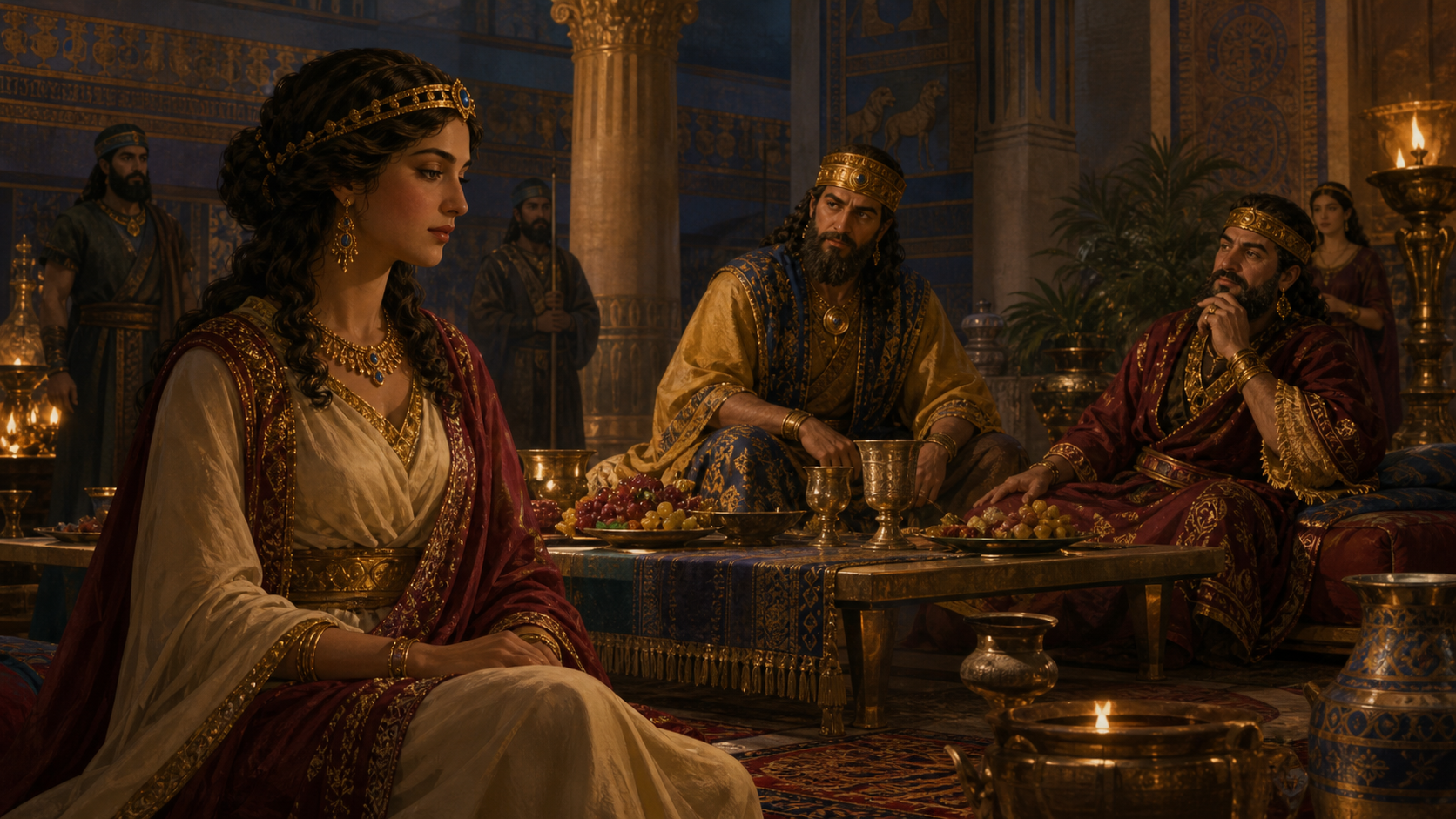
When I first read the Book of Esther, I assumed it was a simple story about bravery. A young Jewish woman becomes queen, exposes an evil minister, and saves her people. But after slowing down and asking a few uncomfortable questions, I realised the story is much richer than that.
One question in particular stayed with me:
**Why did Esther invite the king to a second banquet instead of simply telling him the truth at the first one?**
The answer surprised me.
## A story of hidden timing
Esther is living in the Persian Empire. Her cousin, Mordecai, has raised her after she was orphaned. She eventually becomes queen but keeps her Jewish identity secret on Mordecai's advice.
Then everything changes.
Haman, the king's most powerful adviser, becomes enraged when Mordecai refuses to bow before him. Rather than taking revenge on one man, Haman persuades the king to sign a decree ordering the destruction of all the Jews in the empire.
Mordecai asks Esther to intervene.
She hesitates.
Approaching the king without being invited could mean death.
Eventually she decides to risk everything, uttering one of the Bible's most courageous lines:
> “If I perish, I perish.”
The king welcomes her and asks what she wants.
Instead of telling him, she invites him and Haman to a banquet.
At the banquet he asks again.
She still doesn't tell him.
Instead, she invites them to **another** banquet the following day.
At first, this seems like unnecessary delay.
## What happened during the delay?
Everything.
That night the king cannot sleep.
He asks for the royal chronicles—the official records of the empire—to be read aloud. There he discovers that Mordecai had once saved his life from an assassination plot but had never been rewarded.
The next morning, Haman arrives intending to ask permission to execute Mordecai.
Instead, the king orders Haman to publicly honour Mordecai throughout the city.
By the time Esther speaks at the second banquet:
- the king has been reminded that Mordecai is loyal, - Haman has been publicly humiliated, - the political atmosphere has completely changed.
Only then does Esther reveal:
> “I am Jewish, and Haman intends to destroy my people.”
Haman's plot collapses, and the Jewish people are saved. The story became the foundation of the Jewish festival of Purim.
## Was Esther waiting for a sign?
The text never says she received one.
There are no angels.
No dreams.
No prophecy.
Instead, the story leaves us with a fascinating ambiguity.
Perhaps she was simply an exceptional strategist.
Perhaps she sensed the timing wasn't right.
Or perhaps the delay created space for events outside her control to unfold.
One detail I found particularly interesting is that the Bible never explains why the king couldn't sleep that night.
Many readers see this as divine providence.
I found myself wondering something different.
What if the king was simply anxious?
Imagine his situation.
His favourite queen suddenly risks her life to approach him after weeks without being summoned.
She refuses to tell him why.
She invites only him and Haman to a private banquet.
Then she postpones her request until tomorrow.
Wouldn't you lie awake wondering:
- What is she afraid of? - Why is Haman involved? - Is there something happening in my kingdom that I don't know?
The text never confirms this, but it is psychologically believable.
## My biggest takeaway
I used to think courage meant acting immediately.
Esther suggests something more nuanced.
Sometimes courage is not rushing.
Sometimes courage is waiting until the truth has the greatest chance of being heard.
The Book of Esther is also remarkable because God is never mentioned by name. Yet many readers see God's presence precisely through ordinary events: a sleepless night, a forgotten record, a delayed conversation, and the right words spoken at the right time.
Whether you read Esther as history, literature, or faith, its central question still resonates:
**What if wisdom is not only knowing what to say, but also knowing when to say it?**